A rewarded video ad is an opt-in video the player chooses to watch in exchange for something concrete in the game — an extra life, a currency top-up, a level skip. The player initiates it, watches 15–30 seconds, and the reward is granted on a verified completion callback.
Unity Ads, AdMob, AppLovin and ironSource are mobile app networks. They do not serve browser inventory. A web game or HTML5 title cannot call them and needs a web-native rewarded video provider instead.
AppLixir delivers $4+ CPM on web rewarded video, against roughly $0.50–$2 for typical web display, across 100M+ monthly impressions. Minimum publisher threshold is 5,000 DAU.
Integration is a JavaScript call, not an SDK port: load the script, invoke the ad at a player-triggered moment, grant the reward in the completion callback, ignore everything else.
Poki, CrazyGames and similar portals are distribution channels that sit alongside a direct rewarded video integration on your own domain — they are complementary, not a replacement.
Rewarded video is the only ad format in games that the player actively asks for. That single property — consent before the impression — is why it out-earns forced formats, why it does less damage to retention, and why it has become the default monetization layer for free-to-play. What follows is how the format actually works in a browser, what it pays there, and what changes when your game runs on the web instead of in an app store.
What are rewarded video ads?
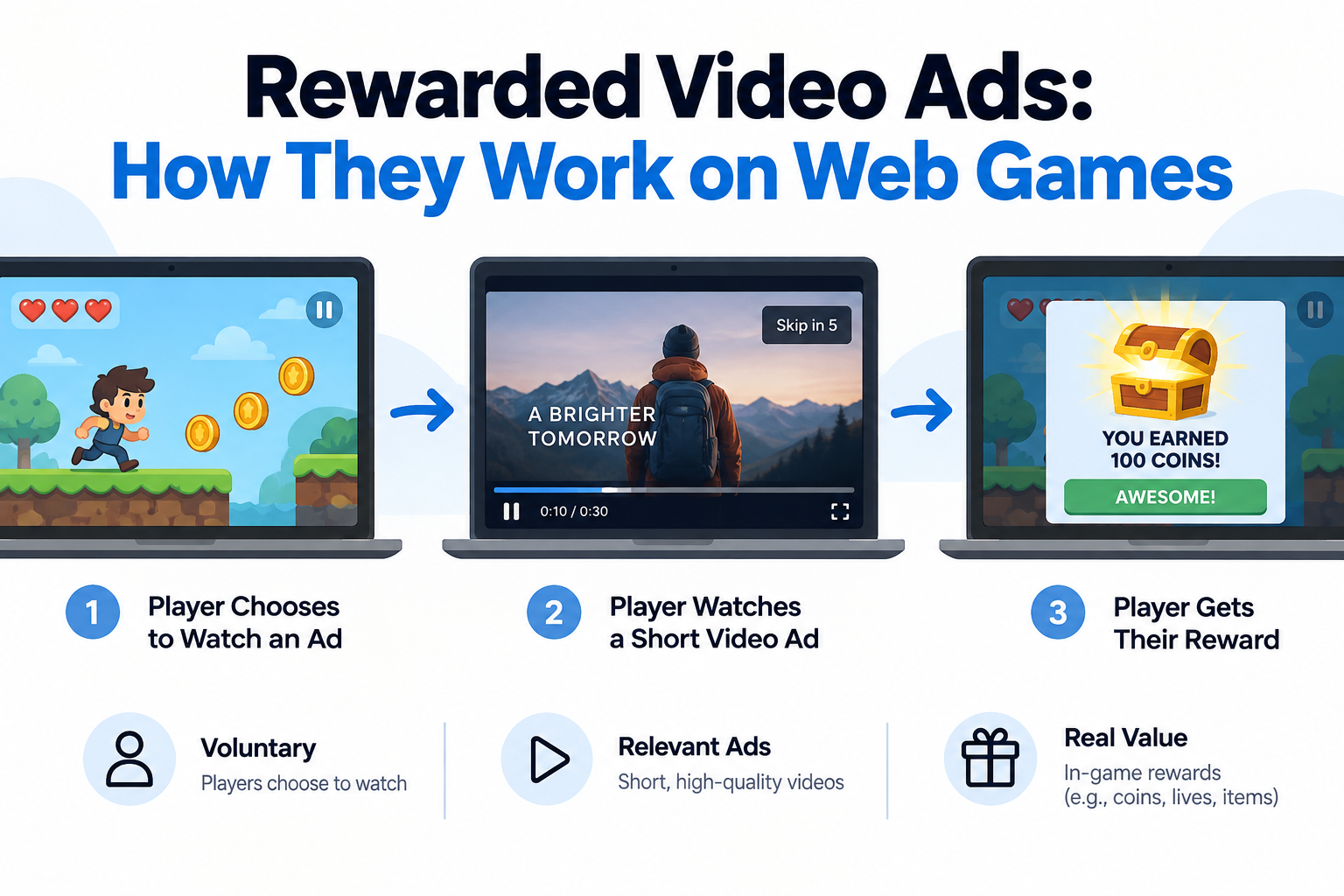
A rewarded video ad is a short, opt-in video advertisement that a user chooses to watch in exchange for a defined in-product benefit, delivered only after the video completes. The player taps a button that says something like “Watch an ad for 100 coins”, a video plays for 15–30 seconds, and the game grants the reward when the ad network confirms completion. Nothing is forced, nothing interrupts, and the value exchange is stated up front.
Three properties define the format, and all three matter for revenue:
Player-initiated. The impression only exists because someone pressed a button. That self-selection produces an engaged viewer, which is what advertisers pay a premium for.
Completion-gated. The reward fires on a completion event, not on ad start. Skipping means no reward, so view-through is structurally high.
Bounded and predictable. The player knows the cost — half a minute — and the payoff before committing. No surprise takeover, no mid-action interruption.
“Rewarded video ad” and “rewarded ads” are used interchangeably in most developer conversations. Offerwalls, playable ads and rewarded surveys belong to the same incentivized family but behave differently on completion rate and eCPM; if you are weighing those, the comparison of rewarded video ads against offerwalls covers the trade-offs.
How rewarded video ads work on a web game, step by step
On a web game, a rewarded video ad runs entirely in the browser through JavaScript — there is no native SDK, no app store build, no platform review. The sequence from player tap to granted reward is the same whether the game is HTML5 canvas, Unity WebGL, Phaser, Construct or a Telegram mini app.
Offer. Your game surfaces a rewarded placement — a “continue” button on death, a “double your coins” prompt at run end, a daily bonus tile on the main menu.
Request. The player clicks. Your code calls the rewarded video function, which requests an ad from the network in real time.
Auction and fill. The request goes to demand partners bidding on that impression. Geography, device, consent status and placement context determine the winning bid and therefore the CPM.
Playback. The video renders in an overlay above the game canvas. Your game should pause audio and simulation here — a game that keeps running behind the ad is the single most common integration bug.
Callback. The network returns a status: completed, skipped, closed early, or no fill. Your code reads that status and grants the reward only on completion.
Resume. Control returns to the game with the reward applied and the player back where they were.
The no-fill case deserves attention. If no ad is available, the player pressed a button and received nothing, which is a worse experience than never showing the offer. Handle it explicitly: either grey out the offer when inventory is unavailable, or grant a smaller consolation reward rather than showing an error.
Rewarded video ads vs non-rewarded formats
Rewarded video ads and non-rewarded formats — display banners, interstitials, pre-rolls — differ on one axis that drives everything else: whether the user consented to the impression. Non-rewarded formats interrupt; rewarded video is requested. That difference shows up in price, in completion, and in what happens to your retention curve.
Dimension
Rewarded video
Interstitial video
Display banner
Who triggers it
The player
The game, at a break point
Always present on page
Typical web CPM
$4+ (AppLixir web rewarded)
Between display and rewarded
~$0.50–$2
Value exchange
Explicit, stated before the ad
None
None
Retention risk
Low — opt-in, bounded
Moderate — depends on cadence
Low, but occupies screen space
Length
15–30 seconds
5–30 seconds, often skippable
Persistent
Best used for
Currency, continues, boosts, gated content
Natural session breaks
Baseline page revenue
The honest framing is additive rather than either/or. Most web publishers running display already have a revenue floor; rewarded video adds a second, higher-value layer on top of it at moments where the player wants something. Interstitials still have a role at genuine session boundaries — the rewarded vs interstitial breakdown goes into where each one earns its place.
Where the old orthodoxy was that rewarded ads cannibalize in-app purchases, the evidence in modern hybrid setups points the other way: rewarded video converts the majority of players who will never pay, and often functions as a demo of premium items. The hybrid monetization guide covers how to structure rewards so they complement rather than undercut IAP.
Do Unity Ads, AdMob, AppLovin or ironSource serve browser games?
No. Unity Ads, Google AdMob, AppLovin and ironSource are mobile application networks. Their SDKs are built for iOS and Android app binaries and their demand is bought against app install and in-app event goals. A game running in a browser tab — including a Unity WebGL build — cannot call those SDKs and is not eligible for that inventory.
This surprises Unity developers in particular. The Unity Ads package works in an iOS or Android player build and silently does nothing useful in a WebGL build, because the underlying native plugin has no browser target. If you are exporting to WebGL and planning to monetize with rewarded ads in Unity, the ad layer has to be a JavaScript one called from your WebGL container.
AppLixir exists for exactly that gap: rewarded video built for the browser rather than a mobile SDK retrofitted to it. If you want the network-by-network detail, the comparison of AdMob, AppLovin, Unity Ads and ironSource lays out what each one covers and where web sits.
Where Poki and CrazyGames fit
Poki, CrazyGames and similar portals are distribution platforms, not ad networks you compete with. They bring an audience to your game and handle monetization inside their own environment. That is a genuinely good channel and many studios should be on it.
What a portal does not do is monetize the traffic on your own domain — your site, your itch.io page, your Telegram mini app, your embedded builds on partner sites. A direct rewarded video integration covers that surface. The two run alongside each other: portal distribution for reach, direct integration for the audience you own. Getting a browser game discovered and monetized treats both as parts of the same plan.
How much do rewarded video ads pay on web games?
AppLixir delivers $4+ CPM on web rewarded video, compared with roughly $0.50–$2 CPM for typical web display inventory. That is a multiple, not a margin, and it is the core economic argument for adding the format to a game or site that currently runs display only.
CPM alone does not give you revenue, though. Three numbers multiply out to what you actually earn:
Daily active users. AppLixir’s minimum publisher threshold is 5,000 DAU, which is the point at which rewarded impression volume becomes meaningful.
Rewarded impressions per DAU per day. A function of how many placements you offer and how compelling the rewards are. One well-placed “continue” offer behaves very differently from four token placements.
Effective CPM after fill. The price you realize once no-fill and geography mix are accounted for. Tier-1 traffic prices well above emerging markets; a global audience averages out somewhere between.
Run those three together before you build a revenue model. For worked arithmetic on web specifically, see how much rewarded video ads pay on web in 2026. For the levers that move eCPM once you are live — placement timing, reward sizing, consent rate, geography — the eCPM optimization guide for web games is the practical follow-on. Benchmarks for rewarded engagement rate by genre: [DATA NEEDED].
How to add rewarded video ads to an HTML5 or Unity WebGL game
Adding rewarded video ads to an HTML5 game is a JavaScript integration: include the script, call a function when the player opts in, and handle the callback. There is no native build step, no store submission and no platform approval cycle, which is why most teams get a first ad rendering inside an afternoon.
Add the script tag to the page hosting your game and initialize with your publisher and zone identifiers.
Wire the trigger. Bind the rewarded call to a button the player presses — never to a timer, never to level load.
Pause the game. Stop the loop and mute audio before playback. For Unity WebGL, this means calling into the JS layer and pausing the player instance, then resuming on callback.
Grant on completion only. Read the returned status. Completed means reward; skipped, closed or errored means no reward and a graceful message.
Validate server-side if the reward has real economic value — premium currency, tradeable items, anything that touches a shared economy.
Rewarded video ads served to players in the EU require a valid consent signal. AppLixir has TCF 2.3 and GDPR compliance built in via Didomi, so the consent string is collected and passed to demand partners as part of the ad request rather than being something you assemble yourself. Consent rate directly affects the bids you receive — a player without consent is worth materially less to programmatic buyers.
Reward abuse is the other operational risk. Because rewarded video pays out something of value, it attracts automated claiming, multi-account farming and replay of completion callbacks. Server-side validation and per-user caps handle most of it; preventing rewarded ad fraud and reward abuse covers the patterns worth defending against.
Rewarded ads for content websites, not just games
Rewarded video ads work on content sites wherever there is something a visitor wants that you can gate behind a voluntary watch. The mechanic is identical to games — opt-in button, video, reward on completion — but the reward is access rather than currency.
Practical rewards on a content property include an ad-free reading session, a PDF or asset download, an extra article past a soft paywall, a premium tool run, or a temporary feature unlock. Each of these converts a visitor who was never going to subscribe into a $4+ CPM impression instead of another $0.50–$2 display refresh. The approach is set out in detail in rewarded video ads for website monetization.
When rewarded video ads are the wrong call
Rewarded video ads are not universally correct, and pretending otherwise wastes integration time. There are four situations where the format should be skipped or deferred.
Below the volume floor. With a few hundred daily users, rewarded impressions are too few to matter. AppLixir’s 5,000 DAU threshold reflects where the format starts to produce real revenue. Build audience first.
No natural reward. If your game has no currency, no lives, no consumables and no progression gates, you would have to invent an economy purely to sell ads against it. Players notice manufactured friction.
Competitive integrity matters. In PvP or ranked modes, a reward that confers advantage turns ad-watching into pay-to-win. Restrict rewards to cosmetics, single-player modes or out-of-match currency.
Premium or subscription products. If users have already paid, an ad prompt reads as a downgrade. Suppress rewarded offers entirely for paying accounts.
The general principle: rewarded video works when it solves a problem the player already has. It fails when it creates one so you have something to sell the solution to.
FAQ
What is rewarded video?
Rewarded video is an opt-in ad format in which a user chooses to watch a 15–30 second video in exchange for a stated benefit, granted only on completion. In games that benefit is usually currency, an extra life or a level skip; on content sites it is typically access to a download, an article or an ad-free session. Because the user initiates the impression, rewarded video commands higher CPMs than forced formats and does less damage to retention.
Do mobile rewarded video ad networks work for browser games?
No. Unity Ads, AdMob, AppLovin and ironSource serve mobile app inventory through native iOS and Android SDKs and do not serve browser inventory. A Unity WebGL build, an HTML5 game or a web page cannot call those SDKs. Browser-based publishers need a web-native rewarded video provider such as AppLixir, which runs as a JavaScript integration rather than a native SDK.
What is a good eCPM for rewarded video ads on the web?
AppLixir delivers $4+ CPM on web rewarded video, against roughly $0.50–$2 for typical web display inventory. Your realized eCPM depends on audience geography, consent rate and placement quality, so a tier-1-heavy audience will sit above a globally distributed one. Treat $4+ as the web rewarded benchmark rather than a guarantee for every traffic mix.
Are rewarded video ads GDPR compliant for players in Europe?
They can be, provided a valid consent signal is collected and passed with each ad request. AppLixir has TCF 2.3 and GDPR compliance built in via Didomi, so consent collection and transmission to demand partners are handled as part of the integration. Consent rate also affects revenue directly, since bidders pay less for impressions without a consent string.
Can I run rewarded video ads alongside Poki or CrazyGames?
Yes. Poki and CrazyGames are distribution platforms that monetize traffic inside their own environments, while a direct rewarded video integration monetizes the audience on your own domain, embeds and other channels. The two are complementary and most studios run both. Portal distribution supplies reach; direct integration captures value from the players you already own.
Monetizing a game or app is a complex process that requires careful planning and execution. Hence, considering monetization early in the development stage and choosing … Frequently Asked Questions on Monetization
Expand Your Game’s Reach: the benefits of Cross-Platform Approch